


Machine Learning
Machine Learning Working Group (MLWG)
The GeoHab Machine Learning Working Group (MLWG) is an association of researchers with interest in Machine Learning methods for benthic habitat mapping.
Purpose:
- To promote machine learning education within the GeoHab community by sharing methods and expertise.
- To work towards consensus on optimal modelling approaches for different benthic habitat mapping applications.
- To establish datasets that are useful for benchmarking statistical modelling methods within the field.
Competition:
The MLWG organizes an annual machine learning competition aligned with the GeoHab conference. The competition is hosted on Kaggle – the worlds largest online data science platform. A different dataset and machine learning task is selected each year, and the winner(s) of the competition is announced at the conference. Scores are evaluated in two ways: i) highest overall, and ii) highest geohabber (conference attendee). Both winners are announced but only the highest geohabber score from a team that attends the conference is eligible for prizes.
2026
Competition page: https://www.kaggle.com/competitions/geohab-mlwg-competition-2026/
Winner (overall): Seyed Mehdi Sadat Hosseini
Winner (geohabber): Alex Wickenden
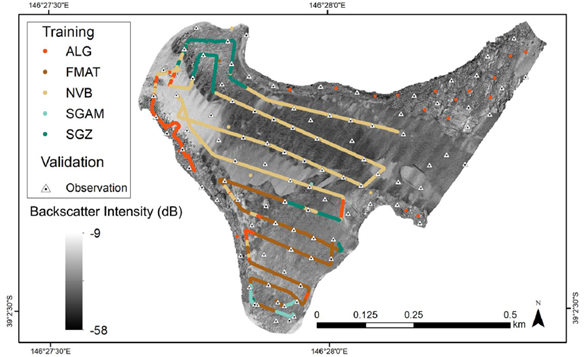
The goal of the 2026 competition was to predict the benthic habitat class observed in underwater video using multibeam bathymetry and backscatter data. The dataset is from:
Ierodiaconou, D., Schimel, A.C.G., Kennedy, D., Monk, J., Gaylard, G., Young, M., Diesing, M., Rattray, A., 2018. Combining pixel and object based image analysis of ultra-high resolution multibeam bathymetry and backscatter for habitat mapping in shallow marine waters. Marine Geophysical Research 39, 271–288.
2025
Competition page: https://www.kaggle.com/competitions/geohab-mlwg-competition-2025
Winner (overall): Oikon – ACOWE
Winner (geohabber): Rock Bottom (Alex Ilich, Klaus Huebert)
For the 2025 competition, participants were required to predict the mean grain size of physical seafloor sediment samples on the Scotian Shelf (off Nova Scotia, Canada), using bathymetric, oceanographic, and geospatial variables.

Interested? Reach out! We are always looking for new ideas or new datasets for the annual competition.
Contact
- Ben (bmisiuk@mun.ca)
- Alex (alex.schimel@proton.me)
- Riccardo (raros@bgs.ac.uk)
Recent Comments